Seawater desalination technology
Due to its high salt content, seawater cannot be directly used. There are mainly two methods used to desalination seawater---distillation and reverse osmosis.
Distillation method is mainly used for large-scale seawater desalination treatment and in areas with abundant heat energy. The reverse osmosis membrane method is widely used due to its wide applicability and high desalination rate.
The reverse osmosis membrane method first extracts seawater for preliminary treatment to reduce seawater turbidity and prevent the growth of bacteria, algae, and other microorganisms. Then, a special high-pressure pump is used to pressurize the seawater to enter the reverse osmosis membrane.
Due to the high salt content of seawater, the seawater reverse osmosis membrane must have high desalination rate, corrosion resistance, high pressure resistance, and pollution resistance. After being treated by the reverse osmosis membrane, the salt content of seawater is greatly reduced, and the TDS content increases from 36000 mg/L to about 200 mg/L. The water quality after desalination is even better than tap water, so it can be used by industry, commerce, residents, and ships.
HID brand sea water RO membrane model SW-8040-HR is suitable for handling purifying complex sea water. Its stable desalination could be up to 99.8% with 800psi inlet pressure. Welcome inquiry!
Performance Specifications:
Model No. |
Feed Spacer thickness (mil) |
Min. Salt Rejection (%) |
Stabilized Salt Rejection (%) |
Permeate Flow Rate (GPD) |
Test Pressure (PSI) |
Test water NaCl (PPM) |
Effective area ft² (m²) |
SW-8040-HR |
28 |
99.6 |
99.8 |
7500 |
800 |
32800 |
400 (37) |
SW-8040-HF |
28 |
99.5 |
99.7 |
9200 |
800 |
32800 |
400 (37) |
SW-8040-440HR |
28 |
99.6 |
99.7 |
8000 |
800 |
32800 |
440 (41) |
SW-8040-440HF |
28 |
99.5 |
99.7 |
9900 |
800 |
32800 |
440 (41) |
1. Permeate flow rate and salt rejection is based on testing conditions: 25⁰C, pH 7.5, 8% recovery.
2. Stabilized salt rejection is generally achieved within 24-48 hours of continuous use, depending upon feedwater characteristics and operating conditions.
3. Active area guaranteed +/- 3%.
4. Permeate flow rate of single element varies by +/-15%.
5. Pressure drop of single element (max.): 15psi.
Operating Limits:
Model No. |
Maximum Operating Temperature |
Maximum Operating Pressure |
Feed Water PH Range, continuous operation * |
Maximum Feed Water Turbidity |
Maximum Feed Water SDI |
Chlorine tolerance |
SW Series |
45℃ |
1200psi |
3-10 |
1NTU |
5 |
<0.1ppm |
* for short term cleaning (30 min.): 2-12.
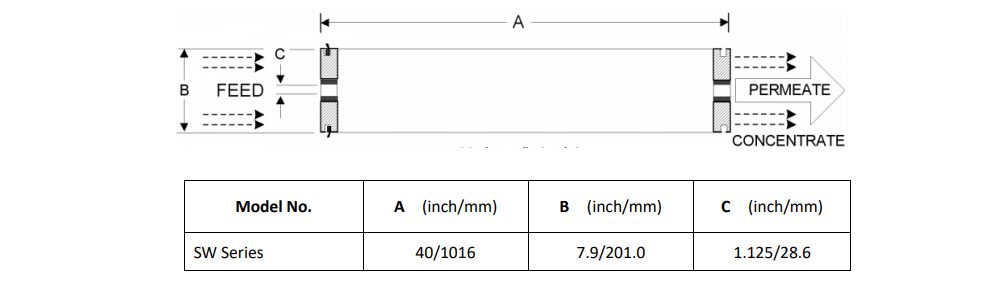
Membrane Dimensions: